DB25 #13 — piiiins iiiin spaaaace
The DB25 connector has plenty of down-to-earth applications but spacefolk need connectors too. It’s easy to imagine that space connectors are entirely a breed apart from regular ones but space is really a one-miracle-at-a-time domain. Let’s get there at all. Let’s get there and back. Let’s get there and back with people, to the moon and back, stay there for a year, etc, etc, etc. You can imagine how far down the miracle list special space connectors would be unless they were needed for some other purpose along the way.
Mostly, they aren’t. Partly because the space connectors may spend years on earth first, so they would be earth+space connectors. Partly because electricity works more or less the same way in space. Materials do behave a little differently. Space has both cold and hot, but earth has had those for a long time as well. Space has radiation, but we started making that on earth in industrial quantities years before we went to space. The trip to space has vibration, but so do many terrestrial processes. Space has kind of a mediocre vacuum — enough to kill you but pretty dirty for high-purity scientific processes unless the scientific purpose is measuring what kind of crap is flying around in space. What the vacuum really means for connectors is that they need to not outgas in a way that either fouls some other component, like a sensor, or that leads to the failure of the connector itself. Other than that, you can build a space-grade version of an earthly connector pretty easily. If they wind up more expensive, it is because the space versions are made in small quantities or because the costs of supply chain integrity far outpace the costs of the thing itself.
A big difference is that are few spacely uses for a kind of connector with ‘positive retention’. Think RJ-45 or Micro-USB. Connectors that stay in unless you trip over the cable, in which case they stay in long enough to drag your laptop off the table and then gracefully disconnect. In space, you want connectors that disconnect smoothly a million out of a million times, because the rocket equation is pitiless when it comes to multiple stages, or you want connectors that stay connected a million out of a million times.
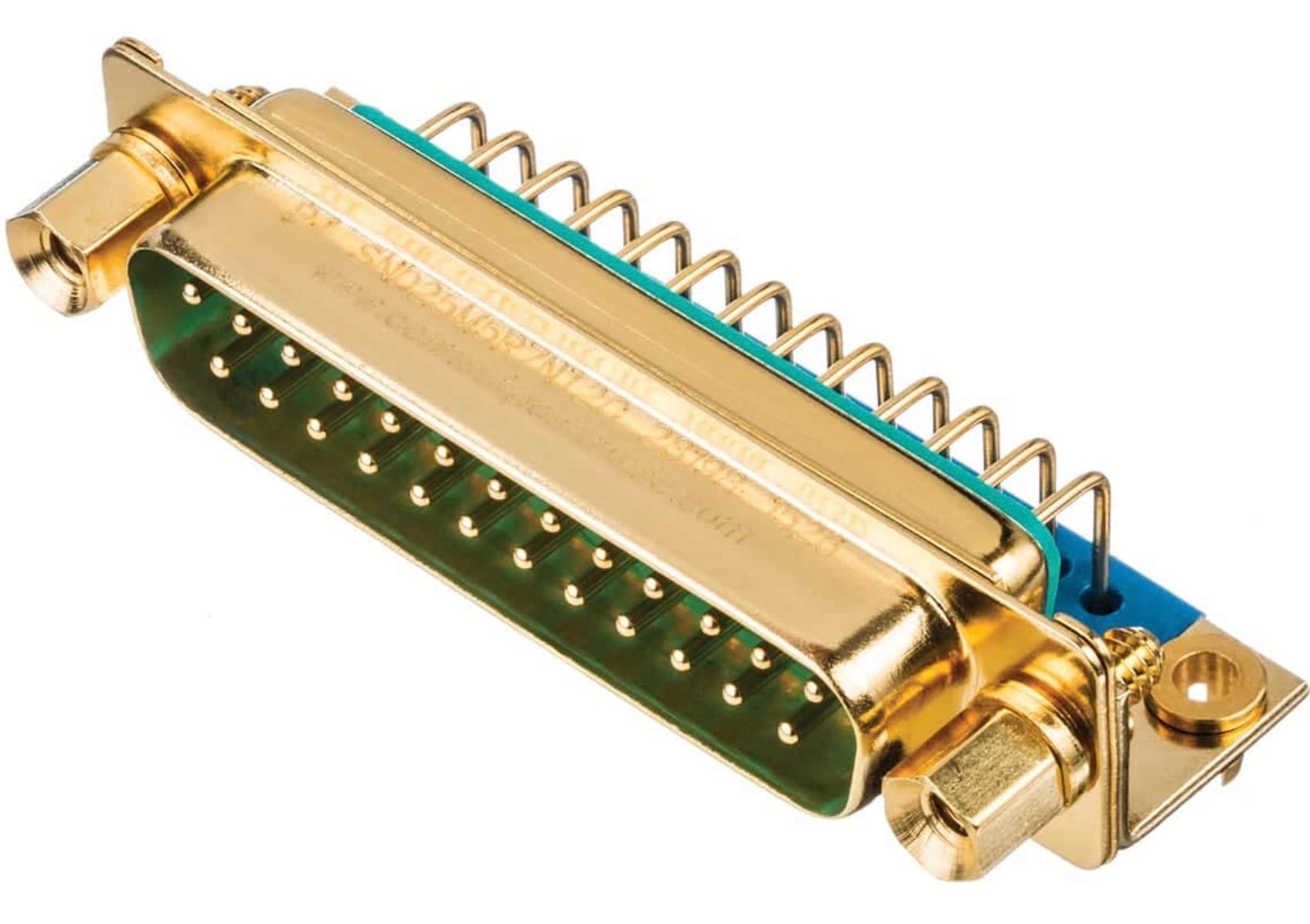
What if you need both? Consider the DB25! Many companies offer space-rated versions. Amphenol’s subsidiary ‘Positronic’ (I am not making that up) offers space-rated DB-25 connectors with or without locks. They are the subject of today’s post.
Space connectors provide mechanical and electrical connection just like on earth. They sometimes also make diplomatic connections. In 1970, NASA and their Soviet counterparts agreed in principal to a joint space mission, notionally around NASA’s Apollo system and the forthcoming Soviet Salyut space station — this is the framework that eventually became Apollo Soyuz.
A major point of contention was how the spacecraft would connect. Apollo already had a docking port, used to connect with the Lunar Module. Salyut had a docking module to accomodate a visiting Soyuz craft. To nobody’s surprise, these were not compatible. Perhaps to the engineer’s surprise, the answer was not simply to pick one and be done with it. You see, we gendered most of our data and mechanical connectors. Neither the Soviets nor the Americans could readily accept the idea that they would be the female participant in any docking — no matter whose connector was used (On behalf of the patriarchy, I apologize for this). This led to the development of the entirely new Androgynous Peripheral Attach System, variants of which are still used.
It was clear, then, that the gendered DB25 connector would simply never be acceptable. More than that, the DB25 connector would never really be acceptable to the Soviets. It was a lackey of imperial units. The Soviets were ruthlessly metric. When the Soviets copied the Boeing B-29 into the Tupolev TU-4, they reconfigured it for metric throughout. Interoperability was no concern, except in the sense that a nuclear exchange could interoperate. Once. D-subminiature connectors of every configuration are very scarce in Soviet electronics. As a practical matter, the cultural differences between cable connectors mattered little for Apollo-Soyuz. There was almost no sense in which the systems were compatible enough to be worth connecting. For the joint portions of the mission, shared equipment (TV cameras, etc) was powered by the fuel cells on the Apollo side.
So who won the Cold War of connectors? It’s not for me to say. While DB connectors are still used, the US-designed universal serial bus has a pleasantly metric connector. Make of that what you will — while the metric system is still legal in the US.
Member discussion