DB25 #17 — ready player one
Before we begin, I want you all to know that we, too, have fired our fact checker in solidarity with Conde Nast. To be fair, both actions are a little performative. They are keen to show that facts no longer matter. We’re signalling that we never hewed especially close to reality in the first place.
I almost bypassed the 16-bit minicomputer era, but for a teenage job as a lab assistant and low-level system administrator of an 16-bit HP 3000 system. I was not a fan and I put the system quickly out of my mind until a few years later when I read Tracy Kidder’s “The Soul of a New Machine” about Data General’s struggles.
To thousands of hackers, Nova is synonymous with DG and the minicomputer era. To me, it’s a long-running show on PBS and a series of unremarkable small cars from Chevrolet. Well, the Corolla-based Nova was a little remarkable. ”Soul” made me much more mini-curious and I’ve been hoping for a looking for a hook to come along and draw me in. Still waiting. Still hoping.
Here’s something for the meantime — the MAS superNOVA.
MAS – Multi-Arcade Systems was a 1990s vendor of arcade-style joystick boxes for home video game consoles. By that time, it was already possible to burn a Playstation with a cigarette in the convenience of your own home. All that remained from the genuine arcade Street Fighter experience was a jar to dump quarters in and a rugged set of controls that could survive years of constant torture. MAS products spanned that bridge, with premium products that cost about the same as a well-worn Joust cabinet.
The home video game consoles of that era were powerful machines in their own right, tacking back and forth across the wind driving the larger PC industry. Just as PCs, few had any real roots back to the 8-bit era.
Arcade video machines lived between worlds. They kept a foot rooted in evolving PC technology, often incorporating commodity microprocessors and RAM parts. This kept cost down, reliability up, and streamlined the ultimately more lucrative market of at-home versions of arcade classics. Arcade hardware kept another foot in a world that looked a lot more like the minicomputer. These were machines that came in real cabinets, which were serviced by technicians, and which were often leased to their customers. In 1981, just as "Soul" was coming to market, the Japan Amusement Machine and Marketing Association (JAMMA) was organizing to make arcade machines even more minicomputer-like with a standardized backplane. Earlier video game cabinets were not so different from video terminals in many respects, with discrete logic coupled closely to the CRT device. This made particular sense in the early video era when games generated their graphics one CRT scan line at a time.
By the mid-80's, the video arcade game and minicomputer businesses looked more alike than they ever had. The guts mattered little. What mattered was the cabinet, the lease, the account, the stranglehold on the customer workflow in markets that would probably never exceed the reach of a single Steely Dan album. The minicomputer industry response was ... to fail. It’s the fashion to say that minicomputers were killed by microcomputers, but that’s not quite true. Minicomputers were killed by their gleeful customers, in favor of not minicomputers. Microcomputers just happened to be the best not minicomputer available.
It was much the same for video arcades, which were killed by not arcades — at more or less the time Orange Julius was digested into Dairy Queen and replaced with not Orange Julius. (Perhaps Cinnabon was the best not-Orange Julius available, that is until malls were replaced with not malls.)
As part of the pivot from arcade cabinets to not arcade cabinets, the JAMMA consortium created an open hardware platform. Unlike the PC, the platform wasn‘t centered around the microprocessor, it was centered around the cabinet. It that way, it was much closer to the ecosystem for AT, then ATX, PC cases than to the motherboards themselves. A JAMMA cabinet had a standardized edge connector into which a video game board could plug and drive the display and speaker, access the joystick, and interact with the coin slot hardware. A laundromat owner could update their cabinet from one game to the next with a just a new board and an updated marquee.
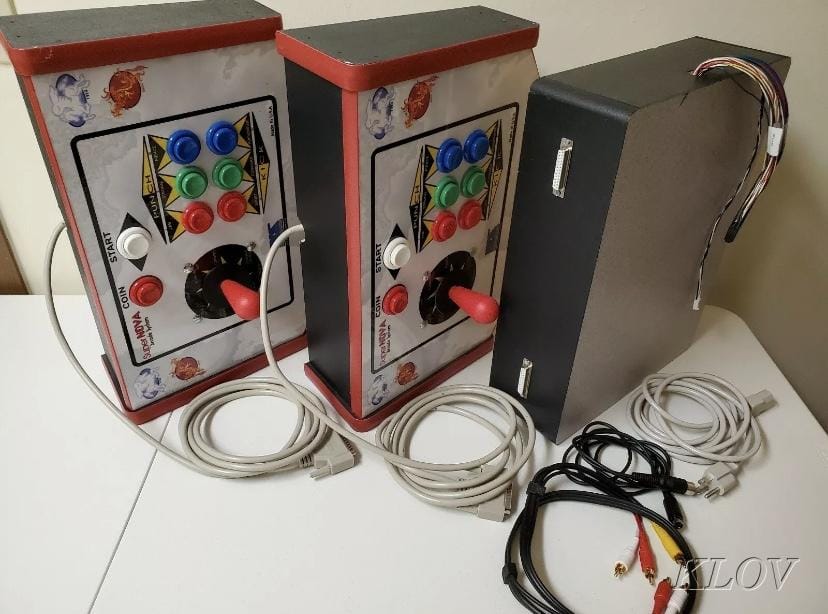
That brings us to the MSX SuperNova. The SuperNova flips the JAMMA cabinet on its head, by providing a way to connect a real arcade video game circuit board to a home television, paired with a set of MSX arcade-style joysticks. Each of the two MSX joystick pods connects to the SuperNova box with a DB-25 cable, and so the MSX SuperNova becomes the 17th entry in our series.
The SuperNova was exceptionally well named. It was a product that only made sense because the arcade cabinet business had already exploded spectacularly, leaving behind nostalgia and an inexhaustible collection of JAMMA-compatible circuit boards for once-popular arcade classics. In many ways, it presaged the MAME emulator that dispensed with the JAMMA boards altogether and simply emulated the original ROM images.
Member discussion