Between computers
I'm moving between jobs this fall, and so reconsidering my personal computing situation. It's because my commute is going to change from car to metro to walking, or because the equipment I carry for work is going to go up or down by 10 pounds, or because I'll be able to keep a phone on my person or because I won't.
It will actually be because I’m on a rare day of vacation or something when I need to simultaneously handle an urgent task for the old job, and an essential leisure function (like managing to get my bag through security at the museum), and a new and unfamiliar business process associated with the prospective job.
I’m looking for a Dynabook, but those just keep not existing. So I'm looking for a machine like an iPad – something that's easy to carry and easy to use on a plane or a train, discreet enough to use in a museum, something with a camera, a gps, cellular connectivity, a good browser. And I'm also looking for a development machine that has the software I want and the keyboard I want and the ports I want and the connectivity to microcontrollers and logic analyzers and garden sprinklers and LoRa meshes. And I want it to fit in my bag together with whatever Outlook and PowerPoint and Adobe Acrobat premium business mobile workstation I'm expected to also tote around. There is a non-zero chance that whatever I’m doing will involve sending or receiving a fax.
~~~~ (shimmer-in flashback effect) ~~~~ So there I was in the office of the county register of wills office, away from home, as I tried to file a report about my mother’s estate just before the office closed. My paperwork was one edit away from the submission they required. They required it on actual paper, though. Can you just print this one page for me if I email it?
There is apparently no Zeus’ law regarding guest printing privileges. Nor was there anything like a Kinko’s within miles of this Odyssey. Didn’t Odysseus spend a year on the isle of Kynkos actually? Cristopher Nolan must have left that out. Surely there was a trick, though. What would Odysseus do? I like to think he would have asked if he could just strike through the original document, annotate, and initial the changes. It can’t all be horses. No? I can’t initial the changes because two copies are required and the must be identical? Could you maybe make a copy of … no. Maybe Xēróks was one of those islands too. OK, time for horses. The trick is that it’s now ten minutes ‘til the office closes. There’s no time for carpentry. I need to skip straight to the part where I climb out of a horse they already have. That horse was the fax machine. With an online fax service I could send them the edited page. I could send it twice. It would roll onto paper and out of their fax machine before they could even stop it. Huh. That actually worked.
That’s why my travel bag now includes a printer. I'm thinking about that now as I lie on the floor having thrown my back out with a bad twist while carrying a personal iPad and a personal MacBook and a developer laptop and a business laptop each for work. And a stream deck. And a HP48SX scientific calculator. And a Kindle. And a set of headphones. And a bag of chargers and dongles. And a travel router. And a wired mouse. And whatever microcontrollers and jumper wires are rattling around the bottom of my bag from some earlier adventure. The open loop function that leads to a 30lb briefcase is this: so long as the next gadget you add weighs no more than 20%, better to have it than carry a stupidly heavy bag and still come up short. This is not what Coco Chanel would do. She would have me take off the last accessory I put on. And then probably a dozen more.
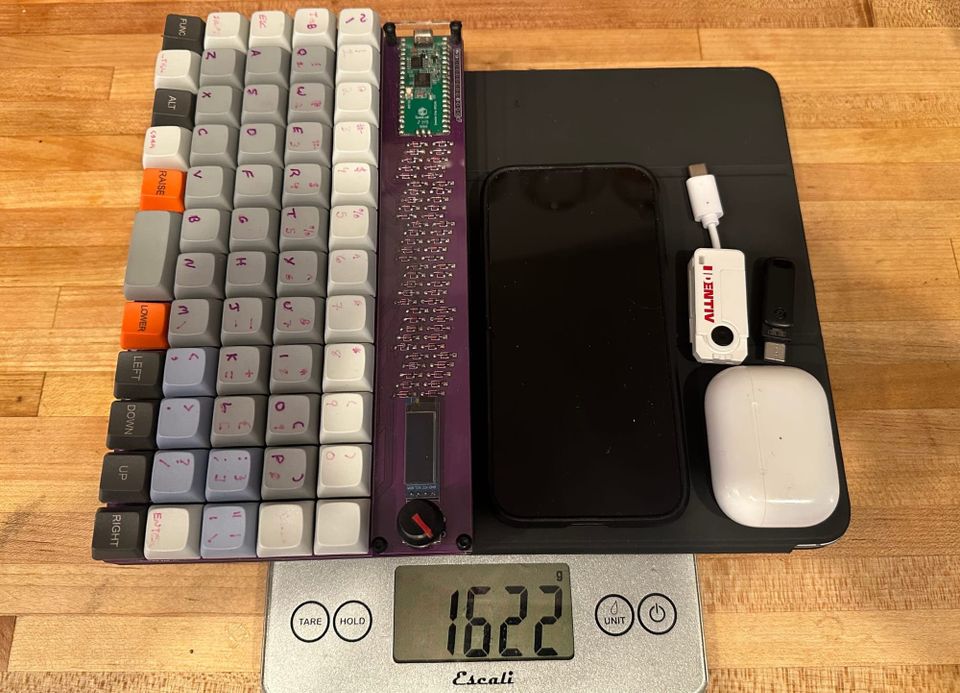
Of all of it, the one gadget that basically never disappoints me is my headphones. They're whatever set of AirPods Pro (the attorneys general of wireless audio) that was for sale in whatever year I walked into a store needing headphones. I think I was supposed to curse them for their closedness and resent them with prejudice for their unrepairability. It's possible that I was also supposed to detest them for their bourgeois nature but I'm softening in my old age. Besides, what if the revolution is televised? I'm going to want to stream it on my flight. Great news, the headphones and their case weigh 62 grams. That's barely more than this post weighs.
Next is the phone. My iPhone 14 Pro weighs 245 grams. A 13 mini with a similar case weighs 180. Is the 14 Pro a whole AirPods Pro better than the 13 mini? Not really.
Next up is a surprisingly light Logitech M100 wired mouse. With cable, it's 88 grams. The mouse itself only weighs 63g with the 6' cable adding the rest. The USB A connector alone adds 8 grams. In fact, the mouse could use a little extra weight. Older mice used to have scrap metal weights inside them. Why isn't the Pi Pico or the SD card reader or something in the mouse? Why can't I flip it over and get a little prototyping area on the underside? An iFixit screwdriver with 4 interchangeable tips adds only 25 grams. It turns out I also had a larger set in my bag with 64 tips, an extension, and a hard case. That weighs only 375g with the case! Do I really need a screwdriver? Yes. Really? Also yes. A set of screwdrivers? OK, maybe not but place a set of screwdrivers in the top of your carry-on luggage and then you have something to give up to security before they get to the even weirder electronics in your bag.
That brings me to perhaps the most troublesome item in my bag. A mechanical 60-key keyboard built from a kit. It's actually a slightly larger cousin of the 48-key keyboard that was the subject of this blog's first post three years ago. That keyboard weighs 450 grams and provides nothing that the laptops do not already have. Not looking good, keyboard. For what it's worth, I wrote several of the chapters of Merrimac on that keyboard.
What's next? While we're weighing keyboards let's weigh the Magic Keyboard cover for my 12.9" 6th-generation iPad Pro. It has a lightweight laptop-style keyboard. Hmm. 720 grams. Seems heavy. What does the non-keyboard case from Apple weigh? Only 250g! The difference there is greater than the entire weight of my unoptimized keyboard with 60 mechanical keyswitches and keycaps. The reason is that the iPad itself weights 925 grams. The keyboard needs extra mass to keep the iPad from toppling over. How much does the keyboard part itself weigh? I don't know that exactly but I happen to have a replacement laptop keyboard here that weighs 120 grams. I could keep either of the keyboards for the same overall weight.
Next is the 15" MacBook Air. That weighs 1700g with a thin case. That's 350g more than the very first MacBook Air from almost 20 years ago. It's 400 grams heavier than the first Dell I could reach from here – a vanilla 5350 that weighs 1300 grams. The second Dell I can grab from here is a 5410 that weighs 1500g and includes an Ethernet port, CAC reader, HDMI port, micro-SD card slot and a SIM tray. This second Dell is the one I usually carry as a development machine. Of course the Dell is made of plastic and even half of that made way for an array of cooling slots. This plastic stuff might just be the future. Maybe the answer was that I didn't need a 15" laptop from Apple and I should have bought the 13" and saved 250 grams. Oh,yeah. I remember this chain of thought. It was clear that the MacBook couldn't do everything the iPad does, so better to make sure it supported the things the iPad couldn't do. In that case why have two 13" screens from Apple in the same bag?
So what are those things? Well, there’s PowerPoint. The iPad version is a completely unserious piece of software. If Microsoft decided it that the iPad could be allowed to have feature parity with the desktop, or with a Windows laptop circa 2000, do I need a Mac?
Oh, also, command-N takes three Mississippis to open a new Safari window on the iPad. For reasons. The iPad falls completely apart once you try to keep more than a few dozen windows open or use multimedia in the background. So Safari, but really it’s a reliable window manager and multi-tasking. The Mac also has a credible terminal app and support for boring and necessary and mysterious and important things like USB serial ports.
What about tens of thousands of concurrent webgl fish in a virtual aquarium? Yes, actually, iPad does this just fine.
So that’s really the heart of it. The iPad could do all the things the Mac does. It has the hardware for it. It just doesn’t do those things and can’t be made to for less complexity than just using the Mac. What does the iPad do that the Mac doesn’t? Well, it has a good stylus. Most of the other things it has that the Mac lacks, like gps and cellular, are present on the iPhone. The on-screen keyboard is large enough in portrait that the best bits of UNIX and C punctuation are available without extra gestures (would that it were true for ctrl, esc, command, cursor keys as well!)
Sounds like I can lighten my load by over a kilogram by ditching the iPad and the mechanical keyboard before I even get to the linux machines, but maybe the way to look at this is not as the lightest covering set, but by the kinds of things I actually produce on these devices and how much I enjoy them. I write this blog mostly on this iPad, even with 20 pounds of other gear in my laptop. If I need a single remote shell, I do it on this iPad in iSH. If I want to read a PDF or a web page, I use this iPad. If I want to charge my dying phone … I use this iPad. I only use one of the other machines if I have to.
I’ve written a version of this post every few years since the iPad came out. Why haven’t I managed to build a Dynabook in all that time? Well, partly because the iPad keeps improving. Not just the kind of raw performance improvements that we take for granted, but changes that bring it closer to a useful general-purpose computer. Things like a real escape key, support for pointer devices, a user-accessible filesystem. Mild relaxation of the rules that would keep out useful apps like iSH. A useful connector. At least token support for multitasking. Recent support for multiple windows in a single app. Meanwhile, the non-iPad platforms that always offered a general-purpose computing environment have made little progress in dynabooking themselves.
The biggest improvement in the last 15 years is that the browser ecosystem is good enough for essentially everything I want to do, and the microcontroller ecosystem is now good enough that I can build the rest there — and program it from the iPad. One of the most essential properties of a true Dynabook was that kids could use it to develop software for itself.
I don’t need to worry about iOS lack of support for WebUSB to configure the keyboard layout. I have written new keyboard firmware in CircuitPython on the iPad and uploaded it to the keyboard through its virtual USB mass storage device. Many of the other missing peripherals can be reached through a virtual Ethernet device running on the same microcontroller running the keyboard. CAC reader? In the keyboard. LoRa? Fits in the keyboard. Serial port? It’s in there.
I think it’s finally the time that everything else that can go — if I’m willing to write a few iOS apps. I think the biggest missing piece is a browser wrapper that splits the difference between ish and QEMU for WASM, that opens URLs from the local filesystem, that can manage some background execution, and a few other things.
It will be obnoxious. And expensive to pay money to sign an app for my own device. And still require a Mac in order to build the darn thing. Does obnoxious weigh less than a pound? Yes. Does expensive take up less space than a mouse? Yes. Does the Mac it requires have to live in my bag? No.
Actually, I’ve already started. I’m finishing this post in my new glass-tiger iOS app using that keyboard. I ordered some PCBs for a small USB hub from this open-source design: https://github.com/Hugoyhu/SL2.1A-Type-C-Hub.git. I’m respinning the keyboard with the additional peripherals and low-profile keyswitches.
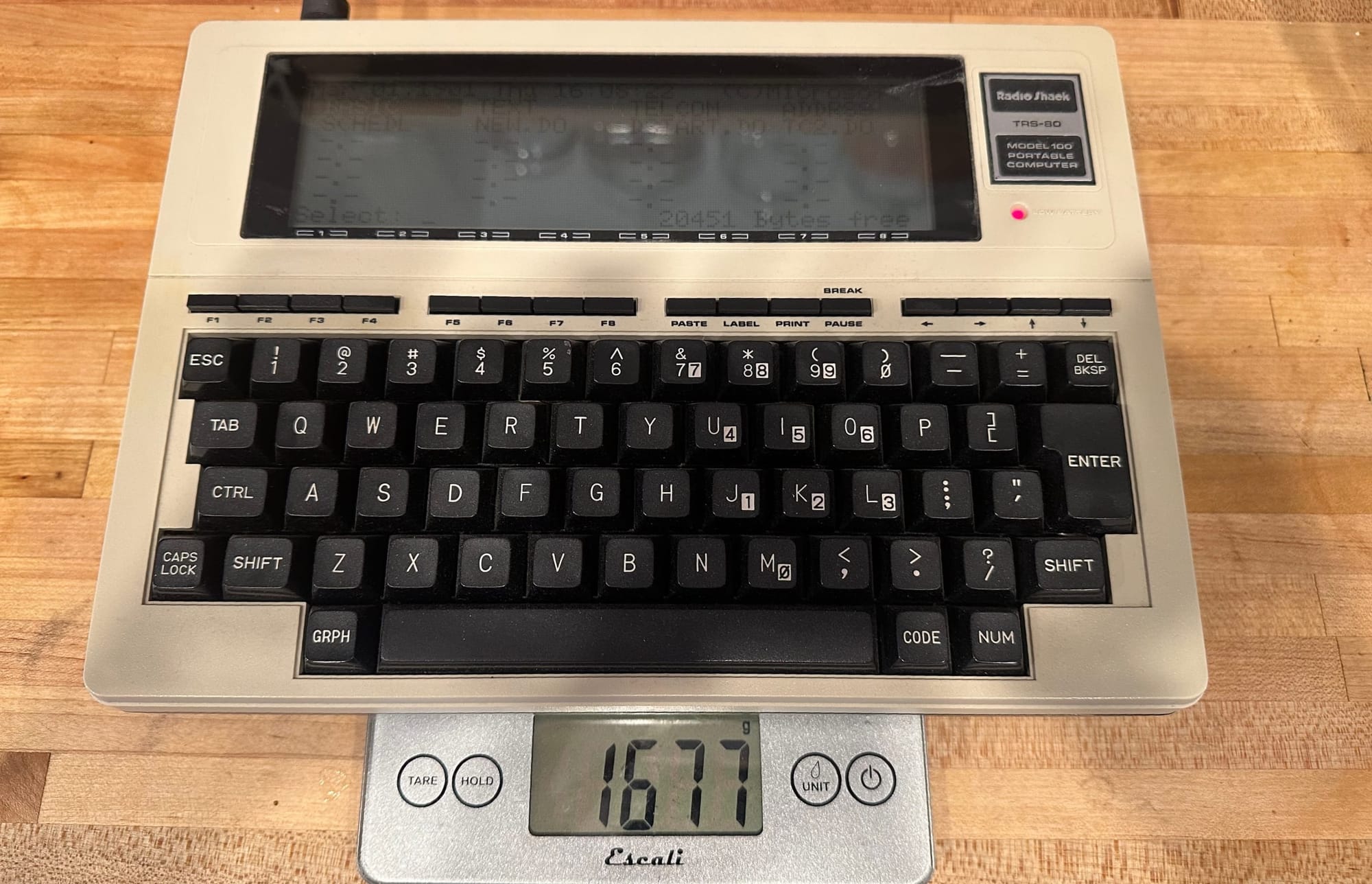
So there’s my 2026 goal — fit my whole personal computing environment centered around the iPad, with cases, cables, stylus, mouse, smartcard reader, phone, GPIO, Ethernet, and all into 2026 grams. Easy enough. Include a tiny thermal printer? That may be a bridge too far though I think I could probably get a letter sized thermal printer down to 500g. As a stretch semiquincentennial, a _independence_ computing environment that keeps it under 1776 grams without the printer. For reference, my TRS-80 Model 100 self-programs, has a modem, serial port, and a mechanical keyboard and weighs less than that with its batteries.
Member discussion