half shell

Botticelli‘s Venus looks good from about any angle on her scallop shell. Your laptop display upon its clam shell? That’s another matter. Wait a minute, why is your display perched on a clamshell anyhow? Laptops didn’t start that way.
The very earliest laptops used LCD displays fixed in the plane of the keyboard. Within only a few years, the clamshell format adopted by GRiD had been almost universally adopted by machines larger than pocket size. Why? Well, display technology allowed larger screens to be built just as framebuffer memory got cheaper, so a fold seemed natural. A bigger issue was the viewing angle and contrast of the display itself. The Toshiba T1000 had a CGA-resolution display with a viewing angle of -15 to 40 degrees and a contrast ratio of 3.5:1. The viewing angle of the CRT on the non-articulating IBM portable was “Yes”. The LCD screen simply had to articulate so long as the machine was too large to be hand held. The soda-lime glass used for the displays was fragile besides.
A CGA display like the Toshiba was even the same sort of size as the keyboard if you used the fashionable modern square pixels. Once screens got a little larger, an empty space opened up, Apple filled it neatly with a trackball and and a palm rest in the original PowerBook.
It’s almost funny that we snake high-speed display and camera cables through tiny laptop hinges the same way we pass critical signals through our fragile spinal columns. This is almost the purest form of Conway’s law:
[O]rganizations which design systems (in the broad sense used here) are constrained to produce designs which are copies of the communication structures of these organizations.
If there was a Moore’s law for hinges and cables, it would be fine that we made a class of computers dependent on moving parts. We get Wright’s law instead. What’s the answer? Well, is there even a problem? I can pick up a new 14” laptop at Best Buy today for $249. That’s an astonishing amount of compute per dollar. But it’s still 20% more than a similar tablet from the same sales flyer.
Generic PC hardware is a ruthless low-margin business. These products are not priced by their perceived utility, they’re priced by the pound. Moving parts bad. Parts bad period, unless splitting somthing into parts gives the buyer (or likely the manufacturer) purchasing power.
The clamshell problem is one that takes care of itself. Just within Apple, iPhone sales outstripped Mac sales more than 6:1 15 years ago. Apple decided that a compact keyboard with no moving pieces was better than the alternative and invested in capacitive multitouch. Screen as input was hardly new, but the resistive era needed input that could serialize and which could tolerate some drift. That’s actually where handwriting excels! On-screen keyboard is almost a pathological application of legacy touch technology. In fact, the basis for Apple’s capacitive product line wasn’t a tablet company at all, it was FingerWorks, the Delaware company that built capacitive multitouch devices intended for use keyboards. If we compare apples to apples, does the on-screen touch keyboard work as a solution to the hinge problem? In portrait, it almost does.
Consider the current Apple iPad Pro 11” as a baseline. That machine weighs 444 grams and has a screen resolution of 2420 x 1668 (4.03M). Base model right now costs $1199. A “Magic Keyboard” costs $299 and weighs an additional 580 grams. If you instead pay an additional $300 on a 13” iPad Pro, you get a 2752 x 2064 (5.68M) screen for 135 grams more than the 11“. The keys of the on-screen keyboard in portrait mode (how I’m writing this now, BTW) take up 650 x 2048 pixels (1.3M). By the twisted economics of Apple retail pricing, making a keyboard out of super-premium micro-led pixels is cheaper and better and lighter than one made from dozens of cheap plastic keys. Almost. It will cost you another 400 grams and $99 to wrap that larger iPad in a non-keyboard case with materials similar to the Magic Keyboard case.
What about viewing angles? Modern LED displays are astonishingly readable. An iPad display has nearly the resolution of a a laser printer from the early clamshell days.
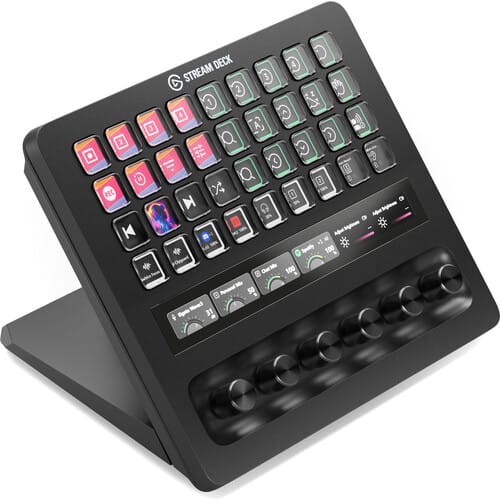
Is slabification coming for all our devices? Will it bring cheapification without enshittification? The folding smartphones might have us believe otherwise, though a iPhone duo is nearly the price of an iPhone Air taped to another one. On the other hand, we have devices like the Elgato Stream Deck that appear to be absolutely button mad but which are essentially a single touchscreen under tactile wrappers.
I think the sweet spot for touch keyboards in-plane with display is around 450g for the whole device, roughly a trade paperback. Any larger than that and you wind up with some kind of stand. If you want to try your hand with a classic Blackberry keyboard, they’re available from AliExpress for $8. Cheap, but probably not as cheap as a touchscreen.
Member discussion